
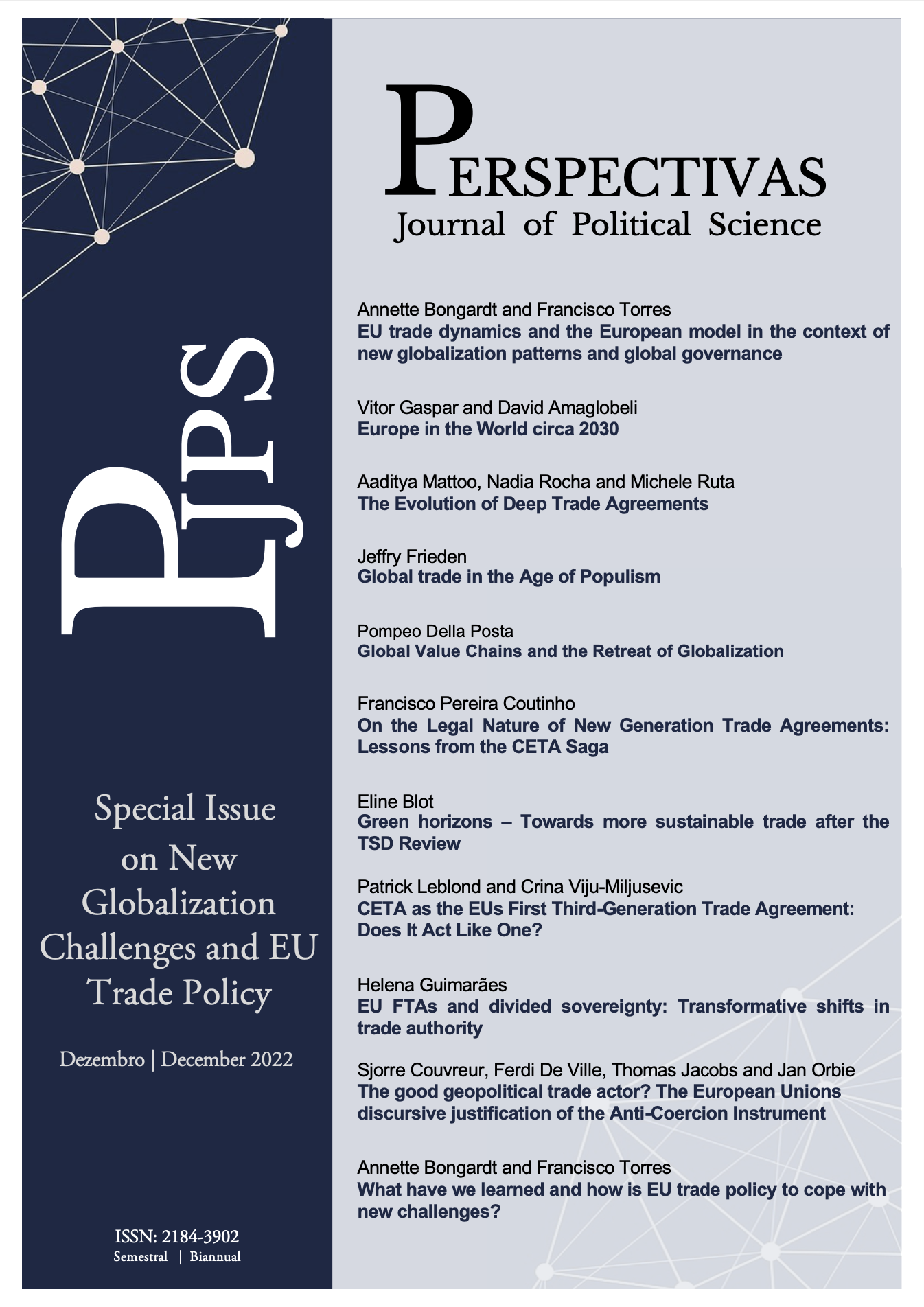
Article 5 - Global Value Chains and the Slowing Down of Globalisation
DOI:
https://doi.org/10.21814/perspectivas.4564Keywords:
Global Value Chains, Extensive and intensive margins, offshoring, friendshoring, nearshoring, reshoring.Abstract
Global value chains (GVCs) have been a major feature of the phase of economic globalisation that began after the 1980s. After the global financial crisis of 2007-08, however, this phase has come to an end, being replaced by one characterized by a significant slowdown in the degree of international economic openness, due to not only economic but also geopolitical reasons.. GVCs have also shown a slowing growth trend after then.
The future scenarios for GVCs, however, suggest the possibility that they may be more resilient than expected.
A first theoretical explanation provided in the literature argues that the reshoring of foreign intermediate production would be prevented by the high sunk costs that would have to be incurred.
However, an additional possible reason for GVCs resilience - this is the main theoretical contribution of this article - is due to the option of friendshoring or nearshoring, rather than reshoring. Moving the production to more suitable foreign destinations, characterized by a political or geographical proximity with the domestic one, would avoid the newly perceived strategic and geopolitical costs, while retaining the economic benefits of offshoring, thereby making GVCs resilient.
Downloads
References
Aksoy, C. G., S. M. Guriev and D. Treisman (2018), "Globalisation, Government Popularity, and the Great Skill Divide". CEPR Discussion Paper No. DP12897.
Antràs, P. (2020), “De‐Globalisation? Global Value Chains in the Post‐COVID‐19 Age”, November 16, Paper written for the ECB Forum on Central Banking, “Central Banking in a Shifting World”.
Atlantic Council (2022), “Transcript: US Treasury Secretary Janet Yellen on the next steps for Russia sanctions and ‘friend-shoring’ supply chains”, April 23. Available at the web address: https://www.atlanticcouncil.org/news/transcripts/transcript-us-treasury-secretary-janet-yellen-on-the-next-steps-for-russia-sanctions-and-friend-shoring-supply-chains/.
Bhagwati, J. (2002), Free Trade Today, Princeton: Princeton University Press.
Bhagwati, J. (2004), In Defence of Globalisation, Oxford: Oxford University Press.
Biden, J.R. Jr., Executive Order on America’s Supply Chains, February 24, 2021
Borin, Alessandro and Mancini, Michele, Measuring What Matters in Global Value Chains and Value-Added Trade (April 4, 2019). World Bank Policy Research Working Paper No. 8804, Available at SSRN: https://ssrn.com/abstract=3366657
Bricongne, J.-C., L. Fontagné, G. Gaulier, D. Taglioni, and V. Vicard. "Firms and the global crisis: French exports in the turmoil." Journal of international Economics 87, no. 1 (2012): 134-146.
Catão, L.A.V. and M. Obstfeld (2019), Meeting Globalisation”s Challenges. Policies to Make Trade Work for All, International Monetary Fund and Princeton University Press.
Connors, E. (2022), “Apple shift shows China’s pain is Vietnam’s gain,”, Financial Review, 2 June, 2022. Available at the web address: https://www.afr.com/world/asia/apple-shift-shows-china-s-pain-is-vietnam-s-gain-20220602-p5aqlm.
Dadush, U. (2022) ‘Deglobalisation and protectionism’ Working Paper 18/2022, Bruegel
De la Dehesa, G. (2006), Winners and Losers in Globalisation, Malden (MA), Oxford and Victoria: Blackwell Publishing.
Della Posta, P. (2020a), “The economic and social costs of globalisation: a target zones analysis”, The World Economy, First published, 17 July 2020, https://doi.org/10.1111/twec.13008.
Della Posta, P. (2020b), “An analysis of the current backlash of economic globalisation in a model with heterogeneous agents", Metroeconomica, First published: 02 September 2020, pp.1-20, 2020, DOI: 10.1111/meca.12312.
Della Posta, P. (2018a), The Economics of Globalisation: An Introduction, Pisa: ETS.
Della Posta, P., M. Uvalic and A. Verdun (eds.) (2009), Globalisation, Development and Integration: a European Perspective, Houndmills: Palgrave Macmillan.
Della Posta, P. (2009), “Asymmetric globalisation: theoretical principles and practical behaviour guiding market liberalization”, in Della Posta, P., M. Uvalic and A. Verdun (eds.), Globalisation, Development and Integration: a European Perspective, Houndmills: Palgrave Macmillan., pp. 19-33.
Dreher, Axel (2006), “ Does Globalisation Affect Growth? Evidence from a new Index of Globalisation”, Applied Economics 38, 10: 1091-1110.
European Commission (2002), “Responses to the challenges of globalisation. A study on the international monetary and financial system and on financing for development”, European Economy, Special Report Number 1.
European Commission (2017), Reflection Paper on Harnessing Globalisation, COM 2017 (240) final, 10.4.2017.
Fischer, S. (2003) “Globalisation and its challenges”, AEA Papers and Proceedings, Richard T. Ely Lecture, Vol. 3, No. 2, pp. 1-30.
Frieden, J. (2019), “The backlash against globalisation and the future of the international economic order”, in The Crisis of Globalisation: Democracy, Capitalism, and Inequality in the Twenty-First Century, Patrick Diamond (ed), pp. 43-52. (London: I.B. Tauris, 2019).
Giglioli, S., G. Giovannetti, E. Marvasi e A. Vivoli (2021), The Resilience of Global Value Chains during the Covid-19 pandemic: the case of Italy, Working Paper n. 7/2021, Dipartimento di Scienze per l’Economia e l’Impresa, DISEI, Università di Firenze, available at the web address:
https://www.disei.unifi.it/upload/sub/pubblicazioni/repec/pdf/wp07_2021.pdf
Grossman, G., E. Helpman and H. Lhuillier (2021), “Supply Chain Resilience: Should Policy Promote Diversification or Reshoring?”, mimeo, September 27. Available at the web address: https://economics.princeton.edu/working-papers/supply-chain-resilience-should-policy-promote-diversification-or-reshoring/ Princeton University.
Gygli, S., F. Haelg, N. Potrafke and J.-E. Sturm (2019): The KOF Globalisation Index – Revisited, Review of International Organizations, Vol. 14, No. 3 ,pp. 543-574, https://doi.org/10.1007/s11558-019-09344-2
Harput, H., (2022), “The hidden costs of frienshoring”, Hilrich Foundation, 15 November 2022. Available at the web address: https://www.hinrichfoundation.com/research/article/us-china/the-hidden-costs-of-friend-shoring/
Hoekman, B. (2015) “Trade and growth – end of an era?”, in Hoekman, B. (ed) “The Global Trade Slowdown: A New Normal?” VoxEU.org eBook, pp. 3-19, available at: https://voxeu.org/content/global-trade-slowdown-new-normal
IMF/WB/WTO (2017), Making Trade an Engine of Growth for All: The Case for Trade and for Policies to Facilitate Adjustment, Washington: IMF. Available at the web address: https://www.imf.org/en/Publications/Policy-Papers/Issues/2017/04/08/making-trade-an-engine-of-growth-for-all
Kinzius, L., Sandkamp, A. & Yalcin, E. (2019), Trade protection and the role of non-tariff barriers. Review of World Economy, Vol. 155, pp. 603–643. https://doi.org/10.1007/s10290-019-00341-6
Krugman, P. (1987), “Is Free Trade Passé?”, The Journal of Economic Perspectives, Vol. 1, No. 2, pp. 131-144.
Krugman, P. (2016a), “Trade and tribulation”, The Conscience of a Liberal, The New York Times, March 11, 2016.
Krugman, P. (2016b), “Globalisation and growth”, The Conscience of a Liberal, The New York Times, March 14, 2016.
Morgan Stanley (2022), Can Thinking Local Fix Global Supply Chains? July 25, Research, available at: https://www.morganstanley.com/ideas/slowbalization-global-supply-chain
OECD (2017), Fixing Globalisation: Time to Make it Work for All, Better Policies Series, April, Paris: OECD.
Olson, S., (2022), “Yellen, Lagarde, and the death of the global trade system”, Hinrich Foundation, 4 May 2022. Available at the web address: https://www.hinrichfoundation.com/research/article/sustainable/yellen-lagarde-global-trade-system/
Oxfam (2016), An Economy for the 1% - How privilege and power in the economy drive extreme inequality and how this can be stopped. Available at the web address: https://www.oxfam.org/sites/www.oxfam.org/files/file_attachments/bp210-economy-one-percent-tax-havens-180116-en_0.pdf
Razin A., Sadka E., Schwemmer,A. H. (2019), "Welfare State vs. Market Forces in a Globalisation Era", CEPR Discussion Paper No. DP13937.
Rodrik, D. (1998), “Why do More Open Economies have Bigger Governments?” Journal of Political Economy, Vol. 106, pp. 997–32.
Rodrik, D. (1999), “Globalisation and labour, or: if globalisation is a bowl of cherries, why are there so many glum faces around the table?”, in Baldwin, R., Cohen, D. et al. (1999), Market integration, regionalism and the global economy, Cambridge: Cambridge University Press.
Rodrik, D. (2001), “The global governance of trade: as if trade really mattered”, Background paper to the UNDP Project on Trade and Sustainable Human Development, October, New York: United Nations Development Programme (UNDP).
Rodrik, D. (2007), “How to save globalisation from its cheerleaders”, KSG Working Paper No. RWP07-038, Harvard, MA: Kennedy School of Governance.
Rodrik, D. (2017), Too Late to Compensate Free Trades Losers, Project Syndicate, April 11 (https://www.project-syndicate.org/commentary/free-trade-losers-compensation-too-late-by-dani-rodrik-2017-04?barrier=accessreg).
Rodrik, D. (2018a), “Populism and the economics of globalisation”, Journal of International Business Policy, Academy of International Business, https://doi.org/10.1057/s42214-018-0001-4.
Rodrik, D. (2018b), New Technologies, Global Value Chains, and the Developing Economies. Pathways for Prosperity Commission Background Paper Series; no. 1. Oxford. United Kingdom
Saval, N. (2017), “Globalisation: the rise and fall of an idea that swept the world”, The long read. The Guardian, July 14, 2017.
Sinkovics, N., & Sinkovics, R. R. (2019). International business and global value chains: Handbook on global value chains. In S. Ponte, G. Gereffi, & G. Raj-Reichert (Eds.), International business and global value chains (pp. 417- 431). Edward Elgar Publishing Ltd. https://doi.org/10.4337/978178811377
Stiglitz, J. (2017), The overselling of globalisation, Business Economics, Vol. 52, No. 3, July, pp. 129–137.
Stiglitz, J. (2006), Making globalisation work, London: Penguin Books.
Stiglitz, J. (2005), “The overselling of globalisation”, Chapter 10 in Epstein, M. (ed), (2005), Globalisation: what”s new, New York: Columbia University Press, pp. 228-261.
Stiglitz, J. (2002), Globalisation and its discontents, London: Penguin Books.
The Economist (2019), “Slowbalisation: The future of global commerce”, 24 Jan 2019. Available at the web address: https://www.economist.com/weeklyedition/2019-01-26.
The White House (2021), Building Resilient Supply Chain, Revitalizing American Manufacturing, and Fostering Broad-based Growth. Available at the web address: https://www.whitehouse.gov/wp-content/uploads/2021/06/100-day-supply-chain-review-report.pdf
Wang, Z., Wei, S., Yu, X. and Zhu, K. (2017), “Measures of Participation in Global Value Chains and Global Business Cycles”, National Bureau of Economic Research Working Paper Series 23222, March, Doi: 10.3386/w23222, http://www.nber.org/papers/w23222
Williamson J.G. (2005), “Winners and Losers over Two Centuries of Globalisation”, in: Wider Perspectives on Global Development. Studies in Development Economics and Policy. Palgrave Macmillan, London, DOI https://doi.org/10.1057/9780230501850_6.
World Bank (2020), World Development Report 2020: Trading for Development in the Age of Global Value Chains. Washington, DC: World Bank. doi:10.1596/978-1-4648-1457-0. License: Creative Commons Attribution CC BY 3.0 IGO University Press.
World Economic Forum (2020), Global Competitiveness Report 2020,
WTO (2021) Global Value Chain Development Report, Beyond Production, November, Asian Development Bank, Research Institute for Global Value Chains at the University of International Business and Economics, the World Trade Organization, the Institute of Developing Economies – Japan External Trade Organization, and the China Development Research Foundation.
Downloads
Published
How to Cite
Issue
Section
License
Copyright (c) 2022 Perspectivas - Journal of Political Science

This work is licensed under a Creative Commons Attribution-NonCommercial 4.0 International License.
Authors must be sure that they have permission to reproduce copyright material, prior to submitting their articles to this Journal.
Authors must secure permission if they have permission to reproduce figures, tables, or any extract from the text of another source. This applies to direct reproduction as well as to any derivative reproduction.
In assigning copyright, authors retain their right to use their own material elsewhere, provided that the Journal is acknowledged as the original place of publication, and the Editorial Team is notified in writing in advance.
Further information on copyright policy please contact info@perspectivasjournal.com